
Product
From fragmented workflows to a Connected experience
Oct 14, 2026

At the beginning of the year, we started looking for a better way to manage our product development process.
We already had an internal tool, Startmap, but it was never the source of truth. The work happened elsewhere and Startmap had to be updated afterwards, so it was always out of date and nobody relied on it. Low adoption was a symptom of that, not the cause.
Product Managers and teams kept tracking initiatives, decisions and updates in their own spreadsheets, docs and boards. Context got lost across tools, handovers between PMs were hard, and understanding why a decision was made often meant asking whoever had been involved at the time.
As a result, a simple question could not be answered by opening a tool: what is happening with this initiative, and is it on track? It was answered by a person. So we answered it the expensive way: in weekly status meetings, in recurring syncs, and in Slack messages asking for an update. Updates were written on request, not as part of the work. So they reflected the moment someone asked, not the real state of the initiative.
Today, that answer lives in Cabify Connect, our own portfolio tool. It is already used by hundreds of people across the company, and (almost) all of Tech’s product work is tracked there. This is how we got here.
Why we decided to build Cabify Connect
We evaluated existing tools, including Linear and Notion. Both are excellent products, flexible enough to adapt to our way of working. But making them fit our product model would require every initiative to be created and maintained through a growing set of custom fields.
Our model connects Key Priorities, Opportunities, Initiatives and Experiments. Reproducing those relationships elsewhere would make every new initiative harder to create and update. That friction hurts adoption. Connect is designed around this model from the start, while keeping engineering execution in GitLab.
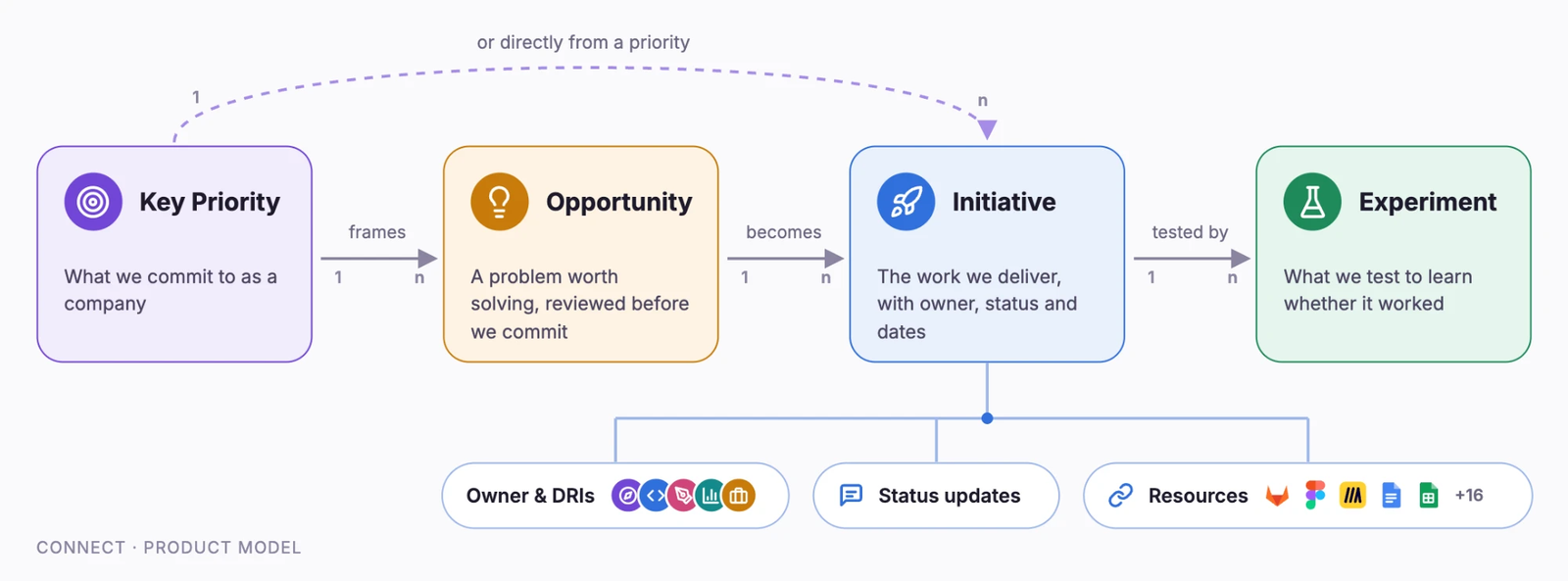 Every initiative can be traced up to the priority it serves and down to the experiments that test it, with its owners, updates and resources in one place.
We also wanted the whole company to be able to read the portfolio. With seat-based pricing, someone who only needs to look at the information costs the same as someone who works in the tool every day. With more than 1,000 employees, that adds a significant cost to our tooling.
That was when building our own tool became a serious option.
Using Lovable, we built the first usable version of Connect in less than two weeks. We did not try to reproduce every feature of Jira, Linear or Notion. We built the layer of product context that our organization was missing.
The economics also worked. Connect’s recurring costs are limited to its infrastructure: Lovable, Cloudflare, Supabase and the AI gateway. The initial version required only €200–300 in AI tokens alongside the team’s effort.
What Connect does today
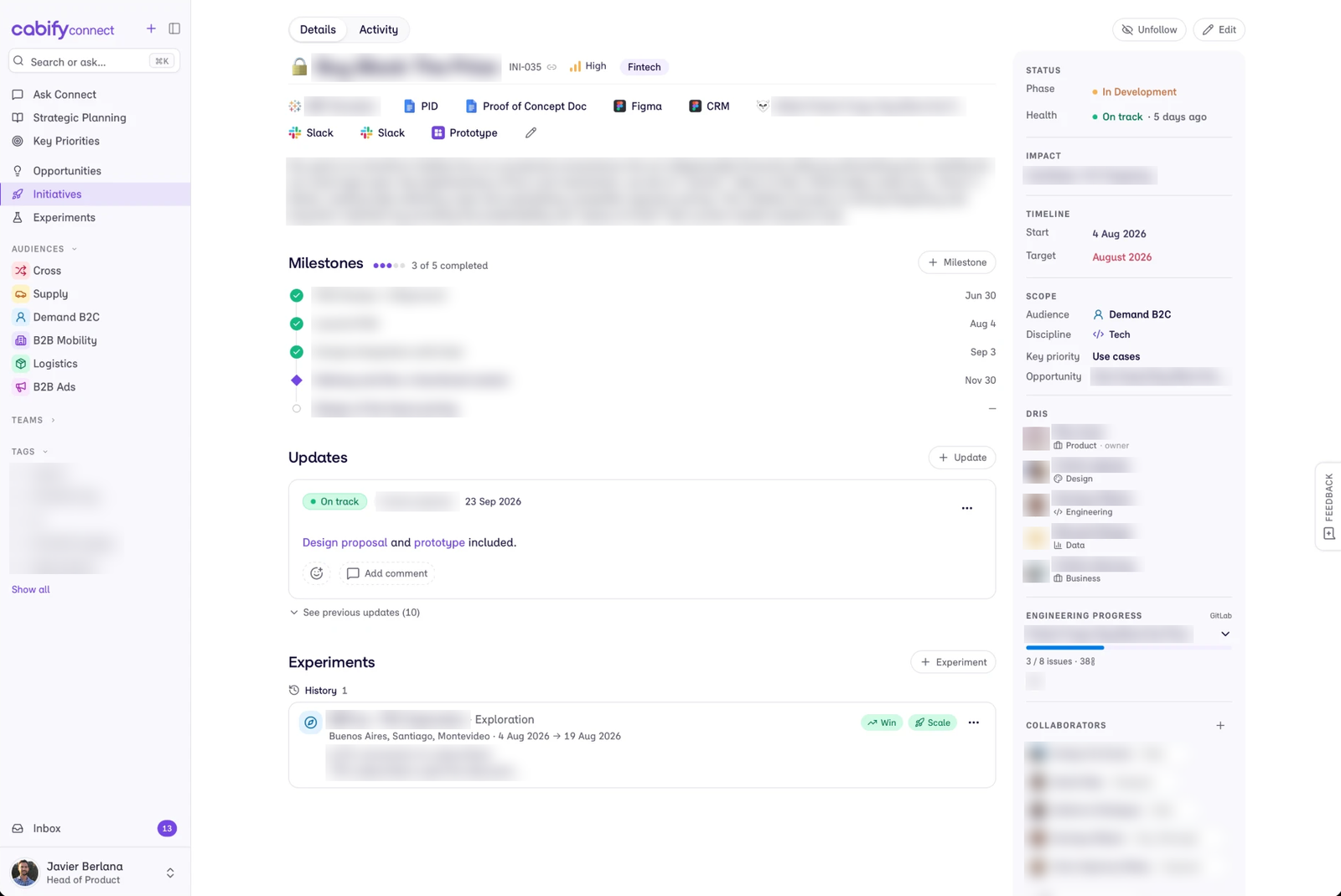 One initiative, one page: resources, milestones, updates, experiments and the people behind it.
At its base, Connect is a product management tool: every initiative has an owner, status, timeline and history. On top of that:
- Views you can share. Teams can switch between list, grid, updates, board and timeline views. They can explore the portfolio by audience, key priority or tag, or search by keyword. Filters are preserved in the URL, so a view can be shared and reopened exactly as it was, with a preview in Slack.
- Visibility for local teams. Teams in each country can see which initiatives and experiments are live in their region, without waiting for someone to tell them.
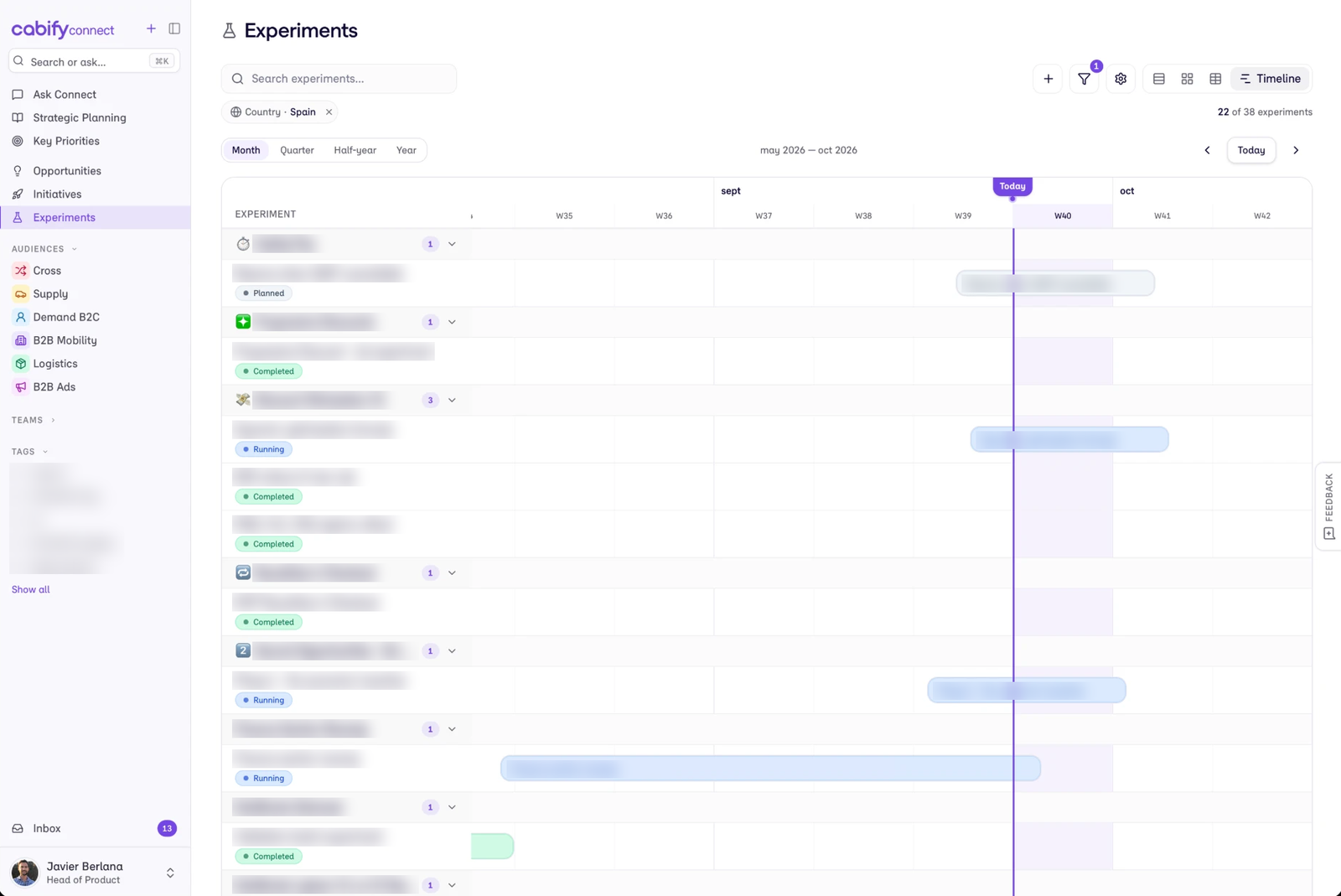 Every experiment in one country, on a timeline, with what is running today.
- Dates with the right precision. A date can be a specific day, a quarter, a semester or a year. A project planned for Q3 should not require an invented date in September.
- Product context connected to execution. The GitLab API brings milestones and issues into the initiative view without asking Engineering to maintain a second source of truth.
- A personal Inbox. It is event-driven, not a static task list. It reacts to a new assignment, a published update, an overdue milestone, a close deadline or the end of an experiment, and takes you straight to the initiative.
- AI on top of the portfolio. On-demand summaries make recent updates easier to scan, and Ask Connect answers questions from product data without inventing what is not there. Through MCP (Model Context Protocol, the standard way AI agents connect to tools), agents can search the portfolio and the context behind past decisions. Teams reuse that knowledge when exploring a new opportunity instead of starting from scratch.
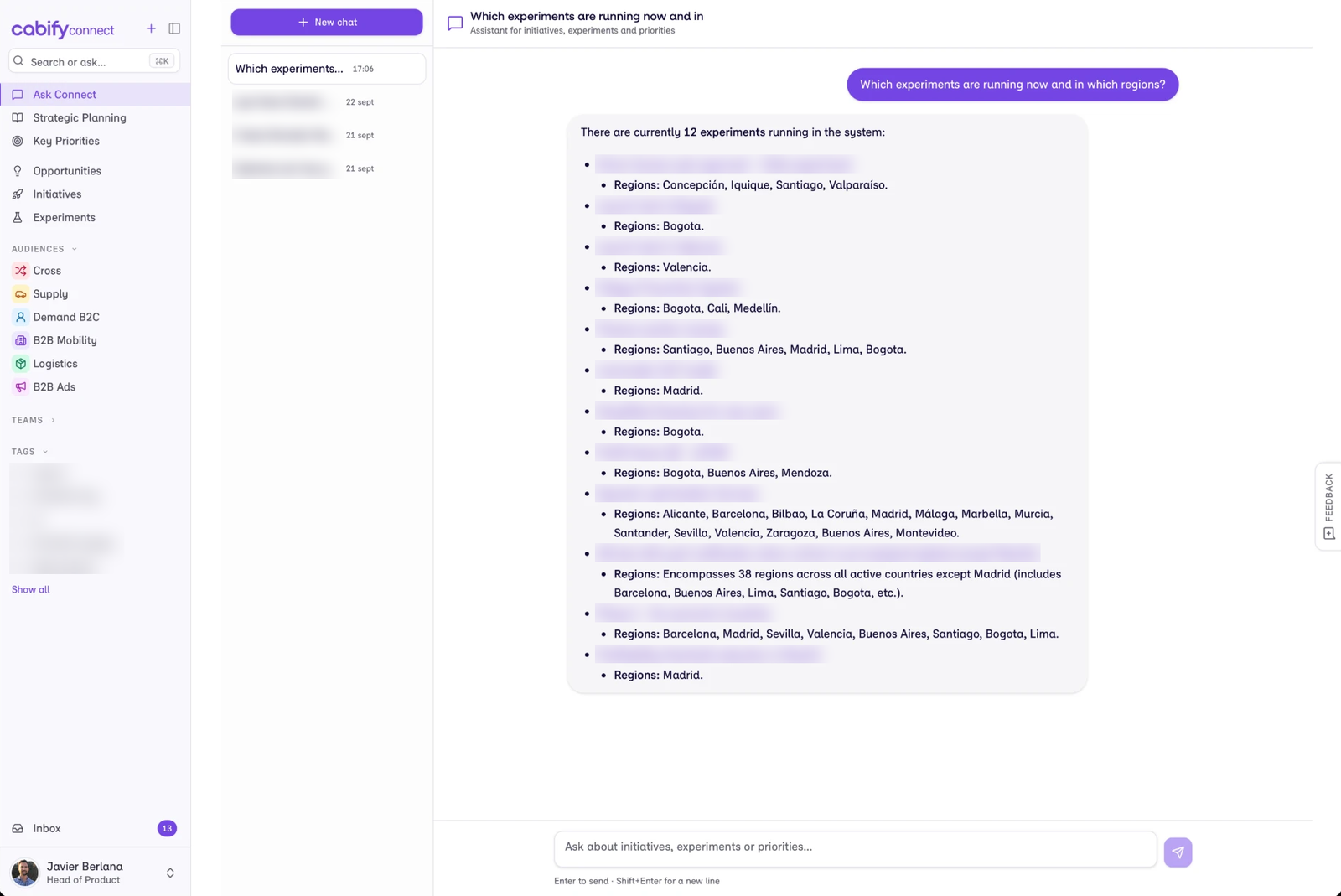 Asking Connect which experiments are running right now, and where.
From MVP to weekly iteration
Connect was built collaboratively by three of us.
- We aligned on the vision of where we wanted to go.
- We validated the direction of some features together before building them.
- We developed separately, each of us whenever it suited us.
The first version was only a starting point. Since the project began in June 2026, we have shipped more than 60 changelog entries. Many of them came from the feedback entry point, where anyone can report bugs, ideas or improvements. That tells us which use cases add the most value.
We refined the initiative creation flow through three iterations in one week. When we found a shared pattern between opportunities and key priorities, we brought them together in a common editor. After a Product Manager pointed out that an exact date could imply more certainty than the team actually had, we introduced five levels of date precision.
Generative AI made these changes fast. It did not replace product judgment. Someone still had to understand the problem, decide what to build, review the result and judge whether it improved the product.
We also used Claude Code to audit the application. That review cut the Inbox from 21 queries per load to 5 and shrank the compressed entry bundle from 438 KB to 331 KB.
What comes next
Connect started as a tool to help Product Managers track their work, but other Tech teams quickly made it part of their day. Now Business teams have asked for access too, and interest is growing across Growth and Operations.
That creates a new challenge: adapting a platform designed around product workflows so other teams can use it without losing the context and structure that make it useful. We are working on five fronts:
- Automated flows instead of manual upkeep. Connect started as a very 2010 tool: someone opens a form and fills it in. We want a 2026 one, where changes take no friction and much of the upkeep happens on its own: syncing an Opportunity Assessment as soon as it is linked, posting a published update to the initiative’s Slack channel, flagging overdue milestones before anyone asks. People and agents will reach Connect from wherever they work: through a bot in Slack, or through MCP, where agents can already search the portfolio and draft status updates. For us, this is the most disruptive part.
- One portfolio for every team. Rather than a separate space per discipline, everyone will share the same portfolio and start from the work that matters to their role.
- A clearer path from idea to delivery. A more explicit flow will help decide which opportunities to pursue. Connect already reviews every Opportunity Assessment with AI: how big the impact is, how well it connects to our goals, what evidence is missing and whether something similar already exists. We want that feedback on every artifact, from opportunities to PRDs and status updates. AI will support the people who review them, not replace their judgment.
- Impact you can measure. Each initiative will be linked to the key metrics it should move. Completing one will mean seeing its results in numbers, not moving a card to the last column.
- Ownership that invites collaboration. It should always be clear who answers for an initiative, without discouraging others from finding an opportunity from another team and lending a hand.
The next stage is broader and harder: make Connect useful to more teams, and bring opportunities, delivery, communication and business impact together in one place.
About the author: Javier Berlana is Head of Product at Cabify, working across product teams on how we decide, build and communicate what we ship. Javier built Cabify Connect together with Eloi Pardo and Sebastián Araos.
If this kind of problem appeals to you, have a look at Cabify’s tech site and at our open positions.

Javier Berlana
Head of Product
Bringing our culture to life through stories—discover it in our blog.
Product
From fragmented workflows to a Connected experience
Oct 14, 2026

Engineering
After the Prompt: How Anyone at Cabify Became a Builder
Oct 07, 2026

Engineering
Stacking
Sep 30, 2026

Engineering
Python Concurrency: Serving ML Without Dying in the Process
Sep 23, 2026

Design
Scaling inclusive design: accessibility as a base
Aug 14, 2026

Culture
The CREP Experience: Building at scale as a fresh graduate
May 28, 2026
Engineering
From Polling to gRPC Streaming at Cabify
Apr 22, 2026

Engineering
From SQL Queries to Real-Time Search
Apr 09, 2026